*PRECIOUS PETALS EMPOWERMENT CENTRE SEEKS BETTER HEALTH SERVICES*
… Solicits supply of more HIV Test Kits, Drugs & Health Workers.
*By: Abiola Akinnayajo, Trumpet* *Magazine*
Precious Petals Empowerment Centre, a non-governmental organization and a Sub-Sub-Recipient (SSR) to NEPWHAN/GLOBAL FUND’s Grant Cycle 7 National TB/HIV Reach Impact Project (N-THRIP), has called for improved health service delivery across primary healthcare facilities in Ondo State.
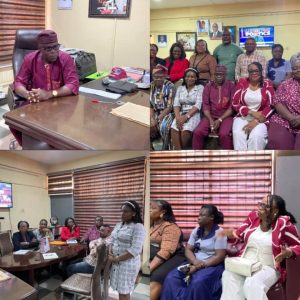
The organization made the call during a State Advocacy Team Visit to key stakeholders in the health sector, where it presented findings from its Community-Led Monitoring activities and highlighted challenges affecting quality healthcare delivery in the facilities.
The advocacy meeting brought together key stakeholders in the state health sector, including the Permanent Secretary, Ondo State Ministry of Health, Mr. Ayodele Adiji, who represented the Commissioner for Health, Dr. Banji Ajaka.
Also in attendance were Pharm. Ekunjimi, a Director in charge of Complimentary and Alternative Medicine; Dr. Gbadebo Aina, Acting Director of Public Health; Dr. Yetunde Olagbuji, Director of Planning, Research and Statistics; Dr. Toyin Adeyalo-Ogundare, State Reproductive Health representative, as well as representatives of the Federal Government and the Network of People Living with HIV/AIDS in Nigeria (NEPWHAN), among others.
There was also a representation of the federal level, Nigeria’s Coordinating Minister of Health and Social Welfare, Prof. Muhammad Ali Pate, CON, team who were also in the state for a visit.
Speaking at the meeting, the Executive Director of Precious Petals Empowerment Centre, Mrs. Stella-Ikeokwu Nathaniel, described the advocacy visit as an opportunity to engage relevant stakeholders on gaps identified through the organization’s Community-Led Monitoring project.
She said the CLM project is currently running across the LGAs with PPEC working in Ondo West, Akure South and Akure North, with a mandate to promote quality healthcare services, particularly in the areas of HIV/TB and malaria.
According to her, the organization places communities at the centre of its intervention by encouraging community ownership and participation in health programmes.
Mrs. Nathaniel explained that in the course of their work, the organization also encounters cases of Gender-Based Violence, noting that about 15 cases had been identified and handled in collaboration with the appropriate GBV structures, including the Ondo State Agency for the Control of AIDS (OSACA), Nigerian Security and Civil Defense Corps (NSCDC), the Nigerian Police Force (NPF) NAPTIP, National Human Rights Commission (NHRC)among others.
She, however, identified three major challenges requiring urgent attention: shortage of HIV test kits, inadequate supply of drugs and shortage of healthcare workers in some facilities.
She appealed to government and relevant stakeholders to ensure the restoration of essential test kits, regular supply of drugs and deployment of additional health personnel to underserved facilities.
Responding to the concerns, the Permanent Secretary, Dr. Ayodele Adiji, said government is aware of some of the challenges confronting healthcare facilities and is already working towards addressing them.
He explained that healthcare delivery involves the three tiers of government and assured the organization that the ministry would continue to engage with relevant authorities to address identified gaps.
According to him, efforts were also being made to accommodate some of the needs within the government budget.
On the shortage of health personnel, Dr. Adiji disclosed that government had recently employed about 2,000 health workers, adding that the government was also looking into further manpower needs across health facilities.
He assured Precious Petals Empowerment Centre of the state’s readiness to support initiatives aimed at improving healthcare delivery and outcomes for vulnerable communities.
Also responding, Dr. Gbadebo Aina, who represented Dr. Fagbemi, said the advocacy visit was timely and expressed optimism that the challenge of inadequate test kits would soon be substantially addressed.
She explained that during supervisory visits, health authorities sometimes encourage the redistribution of available kits from facilities with excess supplies to facilities experiencing shortages.
She added that newly recruited health workers might not yet have been posted to their respective places of assignment, suggesting that the manpower gap could improve as postings are completed.
On her part, Dr. Yetunde Olagbuji noted that some of the identified challenges could be addressed at the local government level.
She called for proper community entry and stronger collaboration among stakeholders to make for smooth running of the project implementation.
*TRUMPET MAGAZINE ONLINE NEWS*
*… blowing it loud & clear!*