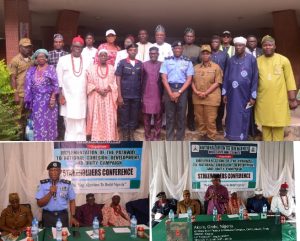
NOA Engages Stakeholders in Ondo to Tackle National Challenges, Promote Cohesion, Unity and Development
In a renewed effort to address the numerous socio-economic and security challenges facing Nigeria, the National Orientation Agency (NOA) has embarked on a Nationwide stakeholders’ Conference across the 36 states and the Federal Capital Territory. The initiative is part of the Agency’s broader commitment to developing lasting solutions that will make Nigeria a safer, more united, and prosperous nation.
One of such engagements took place in Akure, the Ondo State capital, on Wednesday, July 16, 2025, at the Federal Secretariat, Igbatoro Road. The event, organized by the Ondo State Directorate of NOA under the leadership of Mr. James Adekunle, brought together a diverse group of stakeholders representing key sectors of society including security, traditional leadership, civil society, media, religious bodies, and youth organizations.
Among the dignitaries present were the Ondo State Commissioner of Police, CP Adebowale Lawal; the Commander of the National Drug Law Enforcement Agency (NDLEA), Nasiri Dala, represented by Jeyifous Yetunde; and a representative of the Nigeria Security and Civil Defence Corps (NSCDC), Commandant Oluyemi Joshua Ibiloye. Also in attendance were traditional and community leaders such as the Asewi of Gaga Community, High Chief Olu Omotoso; the Asiwaju of Igbos in Akure, Chief Cletus Umenweke and a representative of the Erelu of Akure Land, Chief (Mrs.) Adekanye.
The conference also had in attendance the Chairman of the Nigeria Union of Journalists (NUJ), Ondo State Council, Prince Leke Adegbite; Chairman of the Farmers Congress, Farmer(Dr.) Abayomi Monilari; the Chief Imam of Gaga Community, Alhaji Yusuf Agbesinga; the President of the National Youth Council of Nigeria, Ondo State Chapter, Engr. Babatunde Omomowo; and the Chairman of the Nigeria Union of Teachers (NUT), Ondo State Wing, Comrade Samuel Leke, among many others.
In his welcome address, the NOA State Director, Mr. James Adekunle, set the tone for the conference by highlighting many of the issues currently affecting the country. He urged stakeholders to speak openly, assuring them that the Agency would compile all contributions into a position paper to be submitted to the Federal Government. He also unveiled the NOA’s latest national initiative themed: “Pathway to National Cohesion, Development, and Unity – A Nationwide Peace Campaign for Combating Insurgency, Banditry, Extremism, Youth Restiveness, and Farmer-Herder Conflict.”
The engagement gave stakeholders the opportunity to identify and deliberate on major challenges confronting the country, particularly those affecting the youth. Key issues raised included the rising rate of unemployment, which forces many young graduates into crime or fraud. The growing problem of internet fraud, popularly known as “Yahoo Yahoo,” was also discussed, with concerns that it not only stems from joblessness and greed but also severely tarnishes Nigeria’s global image and results in international sanctions and travel restrictions.
Drug abuse was identified as another pressing concern, with increasing cases of addiction to substances such as codeine, tramadol, and marijuana among both rural and urban youth. This, stakeholders said, leads to mental health disorders, school dropouts, violence, and early death. Cultism, which has become rampant in schools and even neighborhoods, was also highlighted for its role in promoting violence and criminal activity.
Concerns were raised about the impact of social media pressure on the mental well-being of young people, who constantly compare themselves with unrealistic lifestyles portrayed online, leading to low self-esteem and depression. The issue of poor education and lack of practical skills was discussed, with many expressing worry over the disconnect between academic knowledge and the demands of the labor market, further worsened by incessant strikes and underfunded schools.
Political apathy among the youth was noted as a growing problem, with many believing their votes do not count, thereby allowing corrupt leaders to remain in power. Insecurity, particularly banditry, kidnapping, and armed robbery, was discussed as both a cause and consequence of youth marginalization. Stakeholders also addressed the increasing prevalence of transactional relationships, popularly described as “Sugar Daddy/Sugar Mummy” culture, driven by economic hardship and leading to moral decay, STDs, and broken families.
Mental health challenges such as depression, anxiety, and suicide were said to be on the rise among young Nigerians, with stigma and lack of support systems worsening the crisis. Other issues discussed included peer pressure, identity crisis, gender-based violence, and the damaging belief in “connection” over merit, which fuels corruption and undermines genuine talent and hard work.
In response to these challenges, participants proposed a range of realistic and actionable solutions. These included the introduction of skill acquisition programs and entrepreneurship support to tackle unemployment; digital ethics education and stronger law enforcement to curb internet fraud; awareness campaigns and rehabilitation centers for drug abuse; improved campus security and youth engagement clubs to counter cultism; and enhanced access to counseling and mental health support platforms.
To reduce social media pressure, stakeholders recommended digital literacy campaigns and confidence-building workshops. They also called for curriculum reform and an end to frequent academic strikes to address the education gap, alongside stronger civic education to reduce political apathy. Suggestions were made for parenting education, mentorship programs, gender empowerment initiatives, and the enforcement of merit-based systems in recruitment and opportunities.
At the close of the conference, Mr. James Adekunle reaffirmed NOA’s commitment to ensuring that the ideas and recommendations shared by stakeholders would be carefully documented and presented to the Federal Government. He noted that only through unity, shared responsibility, and proactive engagement can Nigeria overcome its present challenges and secure a peaceful, prosperous future for all.