Prince Solagbade Amodeni @70: A Life of Purpose in Politics, Business and Mentorship
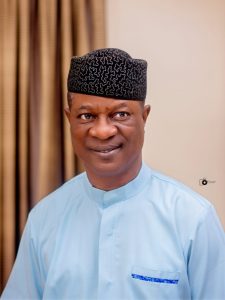
At seventy, Prince Solagbade Amodeni stands tall as a statesman, businessman, and mentor whose life embodies service, vision, and resilience. He served two terms as State Commissioner and one time Chairman of Akoko South-East Local Government Area of Ondo State. He is the Chief Executive Officer of Golden Garden and Vaults, a one-of-its-kind private cemetery located in the serene Olokuta community along Ondo Road, Akure.
In this exclusive interview with The Democrat News Magazine, Prince Amodeni reflects on his early years, his remarkable journey through politics and public service, and his unwavering commitment to community development. The seasoned politician also shared candid views on Nigeria’s economy, the administration of President Bola Ahmed Tinubu, and the leadership of Governor Lucky Orimisan Aiyedatiwa.
Excerpts:
Can we meet you, sir?
I am Prince Solagbade Amodeni. I was born on November 7, 1955, into the royal family of Oba Peter Oduwale and Olori Lydia Wuraola Amodeni, both of blessed memory. My early education began at Methodist Primary Schools in Sagamu and Ijebu-Igbo, before I proceeded to Methodist High School, Ibadan, in 1969. I was an exceptionally brilliant pupil and even won the John F. Kennedy Essay Competition in the then Western Region. However, when I got to secondary school, my interest in formal academics began to wane. I loved learning, but not within the confines of a classroom.
I developed interest in business and at a young age, I ventured into business. In my first year of secondary school, I was promoted on trial to the next class, my parents were displeased and moved me to Victory College, Ikare-Akoko where I was again promoted on trial to Form Three. By 1971, I had lost interest in schooling and decided to train as a mechanic at Ilepa, Ikare.
My mother, however, believed my sudden disinterest in education was a spiritual attack, a common belief in polygamous settings. She persuaded me to return to school, and I later joined the first set of students to write the May/June WAEC examination in 1973. I knew I would not pass, and although it felt like failure at the time, I now thank God for it because that “failure” redirected my destiny.
You see, some failures are blessings in disguise, depending on how one responds to them. Peter in the Bible failed to catch fish until he met Jesus, had he succeeded earlier, he might have missed his divine calling.
While some of my classmates made distinctions, I took a different route. In 1974, I re-enrolled for the WAEC examination at Victory College, Ikare-Akoko, and passed, earning credits in English and Yoruba, and a pass in History. By then, my business had grown steadily. While my peers went off to university, I had already built my first house in Akure.
At that time, there was no “yahoo-yahoo” , no ritual money, no 419, so no one could think that my success was questionable. Every kobo I made came through honest labour. I became the first to sell raw food items in Akure and Ekiti, operating from my shop at No. 41 NEPA Road. When Chief Afe Babalola used his political influence to bring the Federal Polytechnic to Ado-Ekiti, I became the institution’s first food vendor. Later, I diversified into stationery supply and construction.

Through my company, Solicum Nigeria Limited, I executed several major projects: the Great Hall at FUTA, two warehouses at the Federal Polytechnic Ado-Ekiti, including electrical and plumbing works at the Cocoa Industry in Alade-Idanre. I handled some projects in Benin, Ilorin, Gbagi, and Ilara-Mokin.
When did your political journey begin?
I joined politics during Pa Adekunle Ajasin’s administration, initially to pursue contracts but I was ignored. So out of frustration, I began attending Omoboriowo’s meetings. When Baba Ajasin heard, he summoned me. I explained my reasons and he awarded me my first major project, the Health Clinic at Imoru worth ₦75,000 then (equivalent to over ₦750 million today).
About 35 years ago, during the SDP and NRC era, I contested for the NRC Chairmanship but lost to Dr. Tayo Dairo. Later, I joined Baba Adebayo Adefarati’s political group, becoming one of the youngest among veterans like Senator Olorunbe Farukanmi and Chief Korede Duyile.

After General Abacha’s death, I became a foundation member of the Alliance for Democracy (AD), contested the local government chairmanship election, and won. My administration introduced what became Nigeria’s Poverty Alleviation Programme. When President Olusegun Obasanjo visited Ondo State, he commended the initiative and I was later recognized as the Best Local Government Chairman in Nigeria.
I was also the first local government chairman in the South-West to award scholarships to law students, beneficiaries included Barr. Kayode Ajulo, now the Attorney General and Commissioner for Justice in Ondo State, and Barr. Joseph Aremo, Ph.D, current Chairman of ODIEC. I also provided official cars for all traditional rulers in my local government.
Later, I became a foundation member of the Labour Party, and when Dr. Olusegun Mimiko became Governor, he appointed me Commissioner for Natural Resources, a position I held for 23 impactful months.
Years later, Asiwaju Bola Ahmed Tinubu invited me to support Arakunrin Oluwarotimi Akeredolu (SAN). Although Akeredolu lost then, but we regrouped, strategized and eventually secured victory in the following primary election where I served as Returning Officer, overseeing one of the most transparent primaries ever conducted.

I later served for 16 months in Akeredolu’s administration as Commissioner for Physical Planning and Urban Development, where, by God’s grace, we recorded outstanding results and remained in the news for our performance.
After decades in politics, what inspired your venture into private enterprise, particularly Golden Garden and Vault Private Cemetery?
Politics taught me profound lessons about human character. I eventually resolved to pursue this path after seeking God’s face and receiving inspiration from Him concerning the establishment of a private cemetery.
At first, I had no idea such a concept existed in Nigeria, but I obeyed. Within two months, I secured land at Olokuta, unaware it was under a century-old boundary dispute between Akure and Idanre. It took seven years of legal battles before we could take physical possession of the land, which we did three and a half years ago.
Today, Golden Garden and Vault Private Cemetery stands as first of its type in Ondo and Ekiti States. Though we were not the first, our professionalism, impact, and commitment to excellence have set us apart.
I must also commend the current government for sensitizing the public on burial regulations. Many do not realize it is illegal to bury loved ones at home. According to the law, both officiating ministers and family members involved in such burials risk up to six months’ imprisonment. Unfortunately, this aspect of the law has not been strictly enforced.
With your wealth of experience, what should people expect from you going forward?
Perhaps I’ll document my experiences someday. But the question is, are today’s youths ready to read and learn? I discovered my purpose early in life and pursued it with conviction. Over the years, I’ve mentored retired generals, commissioners, permanent secretaries, and others. Mentorship is one of the greatest form of service, and I’m grateful to God for the opportunity to guide others.
As an elder statesman, what’s your message to parents who overlook or support their children’s involvement in internet fraud (Yahoo Yahoo)?
When we speak about Yahoo Yahoo, we often forget it exists in many forms, not only online.
Public servants with questionable wealth, contractors who deliver substandard jobs, traders cheating customers with false measurements, lawmakers misusing public funds, importers of fake drugs, or even food vendors using harmful additives, all these are forms of fraud.
Even some journalists who are subjective, or religious leaders who preach that blessings come only through donations, also contribute to moral decay. True blessings come through hard work, not deceit.
So, when we talk about Yahoo Yahoo, we must look inward as a society. Sadly, many Nigerians practice it in various disguises.
You’re contesting for the position of APC State Chairman in Ondo State. What inspired this?
I am contesting because I’m qualified and experienced. Among all aspirants, I believe I possess the right combination of integrity, credibility, and exposure to move our great party forward. If my credibility and experience cannot earn me the position, so be it, but they remain my strongest credentials. I’m not a man without foundation. I’ve built businesses, I have multiple sources of livelihood, and I have served my people faithfully. My record speaks for itself.
At 70, would you say you’ve achieved your life goals?
That’s a profound question. I’d say I’ve not yet fulfilled even 20 percent of what I set out to do, not because I haven’t worked hard, but because true fulfillment comes from impact. There are still many people I want to help and inspire. As God continues to bless me, I feel an even greater responsibility to give back.
How do you assess Nigeria’s economy under President Bola Ahmed Tinubu?
If we judge by market prices alone, one might hastily conclude that Asiwaju Bola Ahmed Tinubu has failed. But truthfully, he’s one of the best things that has happened to Nigeria.
Personally, I grow my own food, plantain, beans, maize, vegetables and even rear livestocks. Many Nigerians depend too much on others, especially the North, for food. We must return to agriculture and self-reliance.
President Tinubu’s policies are sound, but the challenge lies with those implementing them, politicians and civil servants who frustrate execution. Once local government autonomy takes full effect, governance will improve at the grassroots.
The ongoing road projects, especially the new concrete roads expected to last over 50 years, alongside investments in education, healthcare, and transportation are unprecedented. If we remain patient, by 2027, Nigeria’s economy will be much stronger.
Of course, corruption hasn’t vanished, and insecurity remains partly fueled by foreign interests that profit from our instability. But this government is on the right path.
Finally, how would you assess the administration of Governor Lucky Orimisan Aiyedatiwa in Ondo State?
From what I’ve seen, Governor Lucky Orimisan Aiyedatiwa is performing commendably. Initially, I had reservations, especially regarding uncompleted projects left by the late Governor Akeredolu. However, I discovered that many of those projects lacked proper documentation, which caused delays.
Governor Aiyedatiwa has now begun revisiting and advancing those projects with seriousness. His administration has been quietly effective, but I’d advise that they communicate their achievements more boldly, the people deserve to know the good work being done.
From all indications, Governor Aiyedatiwa’s performance so far is praiseworthy. With continued focus, his administration will leave a lasting legacy of progress and stability in Ondo State.